Showing posts with label Satanists. Show all posts

Monday, October 28, 2019

31 Nights of Halloween: Death Metal

The title of tonight's selection for the 31 Nights of Halloween says it all. It's a straight and to the point tale of a guitar made by Satan himself-- and it's gory and metal as hell! It's a great warm-up for tomorrow's Tuneful Tuesday entry!


Death Metal (2017)
Starring: Michael Dalmon and Kirk Johnson
Director: Chris McInroy
Rating: Six of Ten Stars

Wednesday, October 31, 2012

A movie for those who love classic horror films!

Waxwork (1988)
Starring: Zach Galligan, Deborah Foreman, Michelle Johnson, David Warner, Clare Carey, Dana Ashbrook, Miles O'Keefe, J. Kenneth Campbell, and Patrick Macnee
Director: Anthony Hickox
Rating: Eight of Ten Stars

 A group of college students (Ashbrook, Carey, Foreman, Galligan and Johnson) attend a midnight preview of a new waxwork exhibit in their neighborhood. But this is no ordinary wax museum--it's a place where a minion of Satan (Warner) is trapping victims in the displays as part of a large ritual to unleash Hell on Earth!

Anyone who's thinking about making a hipper-than-hip, self-referential horror film needs to see "Waxwork". Anyone who is thinking about making a self-referential horror film who doesn't have respect for the genre needs to be strapped down ala Malcolm McDowell in "A Clockwork Orange". Because no one who has made movies like that in the past several years--including Wes Craven--have done it as perfectly as Anthony Hickox did it in 1988's "Waxwork".

 Watching "Waxwork" will give lovers of cheesy horror movies the enjoyment of the climactic scenes of the films we love without having to sit through clumsy and padded drek to reach them. As the characters are thrown into the museum displays, we get a great ending to a werewolf movie and great endings or set-ups to vampire mummy movies in the classic Hammer horror and Universal Pictures veins. (Actually, the mummy segment is an especially clever treat for lovers of classic horror movies because it's it's scored with music from "Swan Lake".)

While the acting and assortment of main characters is of the style that was typical for teen comedies and television shows (and therefore maybe not to the liking of some viewers), Hickox delivers a movie that is far more satisfying than any so-called horror comedies being made to day, far more respectful of the films it pokes a little fun at while paying tribute to them, and even far more sensual in places than some horror movies that use that as their main selling point. Hickox and his cast can do erotic and sexy without needing to rely on nudity.

 If you love the old Universal and Hammer pictures, you need to check out this movie. The same is true if you get a kick out of watching old school British actors like Patrick Macnee and David Warner doing their thing. And if you're one of those people who save these sorts of films for Halloween, you need to make a note so you can remember to get this one.

Thursday, May 3, 2012

Paul Naschy is great in 'Devil's Possessed'

Devil's Possessed (aka "The Marshall of Hell") (1974)
Starring: Paul Naschy, Guillermo Bredeston, Norma Sebre, and Mariano Vidal Molina
Director: León Klimovsky
Rating: Seven of Ten Stars

A one-time courageous and dutiful nobleman, Gilles De Lancre (Naschy) grows twisted and bitter because of perceived slights by the king, is led down the path of madness and Satanism by his lover (Sebre). When his crimes and brutality against the serfs in his domain reach monstrous proportions, his former comrade-in-arms Gaston of Malebranche (Bredeston) takes charge of a growing resistance movement and starts laboring toward ending his reign of terror.


Loosely based on historical figures, including Gilles De Rais who in the mid-1400s had as many as 600 children murdered in the name of "dark arts", "Devil's Possessed" is one of the best films written and directed by B-movie legend Paul Naschy. It's a heady cross between a Robin Hood-style adventure tale and a savage, gory Satanism-fueled horror tale that culminates in a "storming of the castle" sequence that's as exciting on a swashbuckling level as it is chilling on a horror level. Few villains get as neat a send-off as Gilles De Lancre gets here.


Paul Naschy gives a great performance as the increasingly crazy De Lancre, with Norma Sebre complimenting him nicely as De Lancre's cold, repulsively immoral lover. Guillermo Bredeston is likewise solid in the role of the righteous Malebranche, but he is needfully outshone by Naschy. Visually, the film is packed with excellent cinematography that takes full advantage of the natural settings and crumbling castles that serve as the film's locations. The action scenes--be they the jousting tournament at roughly the film's midpoint, or the sword-fights during its finale--are also expertly filmed.

If you like some daring-dos with your horror--or some horror with your swashbuckling--I'm sure you'll get a kick out of this one. While a number of Naschy's penned scripts have their roots in the sort of medieval Satanists of this film--with "The Return of the Wolf Man" and "Horror Rises From the Tomb" coming to mind immediately--this is one of the few where they are front and center in their own time. It's an unusual horror film that's well worth a look.

Friday, April 29, 2011

Evil heritage can lead to becoming 'Satan's Slave'

Satan's Slave (aka "Evil Heritage") (1976)
Starring: Candace Glendenning, Michael Gough, Martin Potter, and Barbara Kellerman
Director: Norman J. Warren
Rating: Seven of Ten Stars

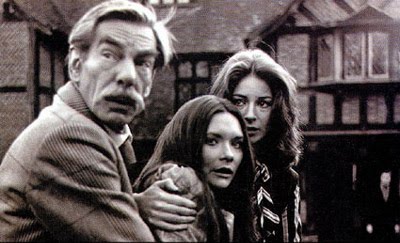
After her parents die in a sudden car explosion, Catherine (Glendenning) is taken in by her uncle (Gough) and strange nephew (Potter). However, Catherine soon learns that she is more a prisoner than a guest and that her uncle intends to turn her body into the vessel for the spirit of a long-dead witch.


Full of psychic premonitions, creepy Gothic manor houses and their even creepier inhabitants, 1970s-style Satanic rituals with naked chicks writhing on altars, and periodic explosions shocking gore, "Satan's Slave" is a one-stop shop for low-budget British horror from that era.

It may also be the best film from Norman J. Warren, as it more successfully sustains an oppressive atmosphere throughout, features better acting and writing than others I've seen from him, and makes far better use of the same thematic material he explored in "Terror". Furthermore, this is one of those very rare horror films that features a twist ending that actually works! While it probably had a greater impact on audiences in the 1970s--where the habit of ending films with a "it was all just a hoax" was still in the childhood movie-going memories of many, and the downer endings that are now so commonplace so as to be annoying were still somewhat unusual--it still offers a surprising jolt for modern audiences. (And by mentioning the surprise twist and that it will cast a pall on the film's finale won't deaden its impact.)

The film is further elevated by a great cast who all do a fantastic job in their roles. Candace Glendenning strikes just the right balance between vulnerability and independence to make Catherine a very sympathetic heroine, while Michael Gough hams it up as the quietly sinister Satanic cult leader to make his performance fun and engaging. They are ably supported by Martin Potter--whose portrayal of a character with a seemingly docile milquetoast personality is a sinister aspect in itself, because we are introduced to him as he commits a brutal, sexually driven murder--and Barbara Kellerman who comes and goes as a near-complete cypher in the picture but is interesting to watch nonetheless. (In fact, Kellerman's character is the only real complaint I can mount about the script; we never gain any insight whatsoever into her motivations or who she is.)

"Satan's Slave" is one of several pleasant surprises lurking within the better-than-average Mill Creek-manufactured 50-movie DVD multipack "Pure Terror". It's one of the prime reasons to purchase the set. The film is available in other collections, but not as economically as it can be acquired in "Pure Terror".


Monday, March 14, 2011

Sometimes a film's best avoided...

Sometimes They Come Back... Again (1996)
Starring: Michael Gross, Hilary Swank, Alexis Arquette, and Jennifer Elise Cox
Director: Adam Grossman
Rating: Three of Ten Stars

When Jon Porter (Gross) returns to his childhood home after the death of his mother, his good-girl teenaged daughter Michelle (Swank) is stalked by the restless spirits of a gang of intensely evil teenaged Satanists, led by Tony Reno (Arquette) he killed as they were killing his sister several decades ago. If Jon is to save his daughter, he needs to kill them... again.


"Sometimes They Come Back... Again" starts out okay but quickly degrades into bad effects and abject stupidity. Even allowing for the standard cast of Stephen King stock characters (the film is based, very loosely, on a short story he wrote, "Sometimes They Come Back") -- the haunted adult who has to face childhood horrors, the 1950s-style tough-guys who are still around as ghosts, the innocent child of the main character who is now being menaced by the dark past, the village idiot, the desperate cleric, and so on--the characters and events here are generally so over the top that it becomes impossible for the viewer to suspend disbelief. And the awful "electricity effects" doesn't help one bit.

It also doesn't help that the only decent actors in the piece are Gross and Swank. On one hand, it's good, because the father/daughter relationship is key to the film's story. On the other hand, it's bad, because whenever they're acting against other players, they show how bad everyone else is.

Truly hardcore Stephen King fans might enjoy this film. The rest of us can just watch it for the beauty that is Hilary Swank...


Friday, March 11, 2011

'The Reaping' nets a thin harvest

The Reaping (2007)
Starring: Hilary Swank, Idris Elba, David Morrissy, AnnaSophia Robb, and Stephen Rae
Direector: Stephen Hopkins
Rating: Five of Ten Stars

A former missionary turned college professor-and-professional-debunker-of-miracles Katherine (Swank) is called to an isolated Louisanna village to provide a scientific explanation for a series of events that mirror the Ten Plagues of Egypt as depicted in the Old Testament. As scientific explanations start to wear thin, Katherine and her deeply religious assistant (Elba) uncover signs that something supernatural is indeed happening in the town--something that may well be of Biblical proportions--and it centers around a 12 year-old girl (Robb). But is she a savior or a destroyer?


"The Reaping" is a fairly standard, paint-by-numbers supernatural thriller with religious themes that will you'll derive enjoyment from in direct proportion to the number of other films in this vein that you've seen. There's not much here that hasn't been done better in other films, although it is well enough paced, decently acted, and decently executed on the technical level. (It does feature one of the best "When Bugs Attack" moments ever put on film, and this sequence is when the film is at its best and its scariest.)

Like so many other modern thrillers, however, its fatal weakness lies with the script. It's not only unoriginal, but its shallow both emotionally and spiritually. The viewer never experiences the pain and horror that caused Katherine to lose her faith in God, and her rediscovery of it is likewise nothing that we feel any emotional investment in. (It's necessary for the plot, but we never get close enough to her--or any of the characters, really--to feel the process happening.)

The film is also not helped by the way it devolves into a special effects extravaganza where the viewer feels even more detached from the action and the characters than at any previous point in the film. Then, just to botch the finale completely, we're treated to a lame "twist-ending" denouement instead of some sort of emotional wrap-up to the story.

"The Reaping" rates a low 5 on the 0 to 10 scale... it's watchable, but there are probably other films you'd be better off spending your time on. It did hold my interest throughout... although I'm not sure if this was to the story's credit or Hilary Swank's tight tanktops and flimsy nightgowns.


Saturday, October 30, 2010

'The Mephisto Waltz' oozes 1970s horror

The Mephisto Waltz (1971)
Starring: Jacqueline Bisset, Alan Alda, Barbara Parkins, Bradford Dillman, and Curt Jurgens
Director: Paul Wendkos
Rating: Seven of Ten Stars

A dying pianist (Curt Jurgins) makes a bargain with Satan to have his soul put into a younger man's body (Alan Alda). The younger man's wife (Jacqueline Bissett) realizes slowly something is different about her husband... and realizes something is seriously wrong people around them start dying mysterously.


"The Mephisto Waltz" is an unsettling little horror film from the 1970s (and it oozes '70s sensibilities from every frame, along with an unsettling sense of dread) that features a surprising twist as it enters the third act and an even more startling ending. It's not often that I am taken completely by surprise by a film's direction, but I was with this one. (And I've just taken three cracks at hinting at the twist while drafting this review, but each time I felt like I was revealing too much and possibly spoiling the film. I feel the surprsing story development here has to be witnessed "cold" to have its full impact.)

As impressed as I am with the ending of the film, it doesn't start out strong. The filmmakers make a tremendous mistake at the beginning of the film by revealing beyond doubt that Alda's character has been possessed by the old man, and that we are dealing with true Satanic magic. By showing us this up front, it removes a degree of mystery and uncertainty that could have make the movie even more suspenseful.

Still, the film does recover nicely from the early blunder, delivering lots of chilling moments, some suitably eerie dream sequences, and one of the best-handled summonings of Satan I've ever seen. It's a film that's worth seeing, and it's a film that doesn't deserve the obscurity it currently endures.


Monday, October 4, 2010

The Complete Night Stalker, Part Two

With episodes Five through Eight, the "Kolchak: The Night Stalker" televisions series looked like it's finally hit its stride. After a wobbly start--with episodes that ranged from good to downright awful, the series presented a string of decent episodes. I know continue the trip through the 1974 television series, as I review every episode in anticipation of Halloween.

Kolchak: The Night Stalker
(The Complete Television Series Reviewed, Part Two)


Episode Five: The Werewolf
Director: Allen Barron
Rating: Six of Ten Stars

When Kolchak is sent on assignment to cover a swingin' singles cruise, he becomes the Reporter Who Cried Werewolf when a murderous beast starts tearing its way through crew and passengers when the full moon rises. Will Kolchak find a priest onboard the ship of sin, so he can get some silver bullets blessed before everyone becomes werewolf chow?

With this episode, the supporting cast at the INS office becomes a major part of the series, and I think the episodes benefit from it--even if Kolchak looks like a total heel with the way he's constantly manipulating and using them. These additional characters coming to the fore heightens the humor of the series, and it gives McGavin recurring actors to play off.

As for this specific story, it's a tense, funny, and fast-paced episode, although the Seventies fashions and "hip" swinger stereotypes can be quite painful to watch. (The couple whose marriage got stronger because they got divorced was pretty funny, though.) The only negative is some of the tall tales Kolchak tells the ship's crew. It's a bit out of character for him to tell such flimsy lies when he knows there's no escape once they're found out.


Episode Six: Firefall
Director: Don Weis
Rating: Seven of Ten Stars

When the friends and associates of a celebrated symphony conductor start dying in mysterious fires, Kolchak smells not only the odor of burning flesh, but also a story. However, what he hadn't counted on was that he would become the target of a restless spirit with a love of fires.

This is another excellent episode that balances drama and humor quite nicely. The threat to Kolchak is once again clear and immediate--if he falls asleep, he's likely to spontaneously combust--and he has to put real thought and legwork into saving himself and the main target of the monster in this episode.

"Firefall" would rate Eight Stars if several early scenes weren't marred by reall bad, really cheap special effects. The episode would have been far better served if the crew had gone with even cheaper effects--simply jump cuts of an actor to it seem as though he was appearing and dissapearing.


Episode Seven: The Devil's Platform
Director: Allen Baron
Rating: Six of Ten Stars

Kolchak is assigned to cover an Illinois State Sentate race where one of the candidates is receiving more than just finiancial contributions from infernal powers. When Kolchak gets too close to the truth, he is faced with a choice between becoming a servant or sacrifice of Satan.

This is one of the episodes I saw a long time ago, and it's every bit as good as I remember it. The strange dog stalking Kolchak after he accidentically takes possession of the evil politician's (played excellently by Tom Skerritt) amulet that is the focus of his demonic power is a particularly effective part of this episode. Another highpoint is the larger part played by the supporting characters in the newsroom. The ending is a bit too easy and pat, though.


Episode Eight: Bad Medicine
Director: Alex Grasshoff
Rating: Seven of Ten Stars

While investigating a series of violent gem heists, Kolchak finds himself on the trail of a shapeshifting, dreamwalking Native American sorcerer who has been cursed with immortality and a never-ending quest for precious stones. Will Kolchak find a way to kill someone who can't be killed... or will he end up in that great newsroom in the sky?


This is another episode that balances comedy and suspense nicely, although I'm sure Richard Keil's Indian sorcerer character looks goofier to modern viewers than he did to those watching in the mid-70s. (And his appearance wasn't supposed to be one of the funny bits, I am certain.)

Kolchak has to use his brains to defeat the threat in this one, and that always makes for a more interesting episode than him just blundering around and getting lucky. The ending  is also pretty strong. All in all, one of the better installments in the series.


Friday, August 27, 2010

'The Last Exorcism' all but ruined by ending

The Last Exorcism (2010)
Starring: Patrick Fabian, Ashley Bell, and Louis Herthum
Director: Daniel Stamm
Rating: Five of Ten Stars

A professional minister and exorcist who has lost his faith in God (Fabian) cooperates with the making a documentary intended to expose exorcists and exorcisms as the frauds they are. However, with a two-person film crew in tow, he comes face to face with a girl (Bell) who may truly be possessed by a demon.


"The Last Exorcism" is, for most of its running time, a well-executed horror film in the "Paranormal" or "The Blair Witch Project" mode. The documentary feel is scrupulously maintained, and there's nothing shown in the film that couldn't have been captured by the camera carried by the documentary filmmaker. The script is lean, tightly focused, and it sets up everything that occurs in the picture nicely.

The film also benefits from a main character, Reverend Cotton Marcus, who, despite admitting up front to having turned from preacher to conman and trickster, is a sympathetic throughout. Even better, Cotton Marcus is a character who has a conscience and a heart--and perhaps more faith left in God than he realizes--and he tries his best to help a young girl in serious trouble, first exploring every possible logical explanation for her condition... and ultimately exploring supernatural ones. He transformation from huckster to hero that Marcus undergoes makes him a character that the audience is rooting for more strongly than most horror movie characters. Of course, it helps immensely that Patrick Fabian is perfectly cast in the part.

Also perfectly cast is Ashley Bell. She's in her mid-20s, but she nonetheless passes just fine as the 16-year-old she is playing. She also shows that maybe she is being wasted in the primarily voice acting roles she's played up to this point, as she is fabulous as Nell, being equally sweet, sinister, or absolutely bat-shit crazy depending on what is called for vis-a-vis portraying a girl who might be demonically possessed. Louis Herthum as her deeply Christian father is likewise excellent in his part, seeming likeable but with just enough of an edge that the audience can buy into the suspicions that start to form around him halfway through the film.


Unfortunately, all that is good about "The Last Exorcism" is undermined by its absolutely awful ending. It's an ending that's carefully set up as the film unfolds, and it's to be expected given the genre and the general tend for horror movies to be home to various degrees of irony and "poetic justice", but in this specific case the ending destroys the carefully constructed illusion that we're watching a documentary. As the end credits start to roll, even the most unquestioning and generous-minded viewer will be asking with some irritation, "Given what just happened... who made the movie?"

I don't know if this was the filmmakers intent, but what they ended up doing was the modern-day equavenent of the ending on "The Mark of the Vampire" or "The Ghoul" where the 1930s filmmakers ended their films by reassuring audiences that there is no such thing as the supernatural. With "The Last Exorcism," the filmmakers do the same by completely destroying the pretense that everything we've just seen unfold on film was just so much make-believe, reassuring us that there is no such thing as the supernatural. However, in the case of the classic horror films, the entirety of what had been built up was not swept away as it is here.

If "The Last Exorcism" has been five-ten minutes shorter and/or given an ending that was in keeping with the illusion of reality the film had set up--even if that ending involved demons taking on physical form--this could have been a great horror movie. Instead, it ends up barely rating as average.


Monday, July 12, 2010

Did the ending get lost in 'The Ninth Gate'?

In a naked attempt to establish myself as a Serious Film Reviewer, I am posting a review of a Roman Polanski movie. I want to be part of the impromptu web-wide celebration that that the convicted child rapist will continue walk around free. (Click here if you haven't heard the news yet.

Yes, Virginia (and Woody and Whoopie) you CAN be a convicted rapist and still be treated like a celebrity AND as if YOU were the victim.

You can even get your movies reviewed at Terror Titans, because I'm a Serious Film Reviewer Who Respects Great Artists (even if they are child-raping cowards who can't man up when it is time to face justice).

The Ninth Gate (1999)
Starring: Johnny Depp, Emmanuel Seigner, Lena Olin, and Frank Langella
Director: Roman Polanski
Rating: Five of Ten Stars

Dean Corso (Depp), a rare book dealer with a shady reputation, is hired by the mysterious Boris Balkan (Langella) to authenticate a copy of a rate book supposedly co-authored by Satan himself. As Corso goes about about his assignment, he is drawn into a web of conspiracy and murder as he gradually uncovers a secret that's been hidden for centuries. Will Corso uncover the occult secret of the Ninth Gate, or will he die trying?


"The Ninth Gate" is a stylish supernatural mystery tale. It's a well-acted film populated by eccentric characters and possessed with a stylish look and a perfectly paced story. It's a film that has almost all the elements of a great thriller, but the pieces that are lacking ultimately doom it.

First of all, the film is predictable. There are virtually no surprises as the film unfolds. The one point where the film MIGHT have take an unexpected turn--with the mysterious girl (Seigner) who may be Corso's only ally or the greatest threat he faces--ultimately ends up in the trite and tired territory. And that's a shame, because the physical presentation of The Girl is unusual and nearly unique in cinema, and, frankly as I would expect a supernatural being walking unnoticed upon the Earth to appear. (It's not a spoiler to reveal here that The Girl is a supernatural being; the film itself makes that clear fairly early on. It's a shame the filmmakers don't ultimately do something more interesting with her than they do.)

Second, and most damning, is the completely botched ending. After two hours of build-up, we get nothing. And I mean that literally. The mystery of the ninth gate is solved, the bad guys get theirs in some very satisfying ways, but the story of Dean Corso and his dark journey of discovery just sort of peters out. The film ends with no resolution of its main story--and not in a cheesy "hey kids, look for the sequel!" way. There is no question that this is a take that's over... the audience just doesn't get to know the ending. More so than any other film that I enjoyed every minute of (except the last minute), "The Ninth Gate" had me saying, "That's it?!" as the credits rolled.

If there ever was a movie that's spoiled by its ending, it's "The Ninth Gate." Unfortunately, the film is such a finely crafted effort that I can't even advise turning off the movie at a certain point to salvage it. Basically, this is a movie that ultimately adds up to nothing. That was probably the director and screen writer's intention, but that doesn't make it any better.


Monday, July 5, 2010

'End of Days' is not cataclysmic

End of Days (1999)
Starring: Arnold Schwarzenegger, Gabriel Byrne, Robin Tunny, Kevin Pollack, Rod Steiger, and Udo Keir
Director: Peter Hyams
Rating: Six of Ten Stars

Jericho Cane (Schwarzenegger), a world-weary detective, must fight against personal temptation, Satanists, a secret sect within the Catholic church,and Satan himself (Byrne) to protect a young woman named Christine (Tunny) and prevent the End of Days from occurring as the 20th century gives way to the 21st.


"End of Days" is a collage of cliched characters, stereotypes, and action scenes that resolve themselves pretty much as one would expect. It's to the supernatural thriller as "Predator" was to the monster movie, although not quite as expertly paced, nor as well acted. (While Gabriel Byrne makes for a great Satan, Schwarzenegger doesn't quite have the range that the part of Jericho Cane calls for--he can't pull off depressed OR religiously enraptured, and the role needs an actor who could have done both.)

The biggest weakness of "End of Days", which causes it to barely rate a Six, is that the director didn't know when it was time to start the climax of his movie. He seemed to feel obligated to cram in one more chase and explosion in the NYC subway even though dramatically the movie should have moved to its resolution once Jericho rescued Christine from the gathering of Satanists on New Year's Eve.

Although entertaining, and its creators deserve credit for attempting to make a different sort of action movie, "End of Days" is just too flawed to rise above average. You can easily save watching this movie until end-of-the-world mania comes back into style in 2011 and 2012.


Saturday, June 26, 2010

Kate Jackson provides chills in
'Satan's School for Girls'

Satan's School for Girls (1973)
Starring: Pamela Franklin, Kate Jackson, Jamie Smith-Jackson, Lloyd Bochner, Cheryl Ladd, Jo Van Fleet, and Roy Thinnes
Director: David Lowell Rich
Rating: Six of Ten Stars

While searching for the truth about her sister's suicide, Elizabeth (Franklin) enrolls as a student at the all-girl boarding school she attended. The faculty and girls all seem friendly enough--especially insta-best-friend-on-campus Roberta (Jackson)--but with a title like "Satan's School for Girls", you gotta know there's witchcraft, evil rites, and guest lectures by the Horned One himself going on.


"Satan's School for Girls" is a better-than-average made-for-TV movie from the mid-1970s. Although uneven in its pacing (partly due to the constricting nature of broadcast TV and the habitual, barely veiled recapping of what's happened to catch up those who tuned in late), there is a nice aura of unease that hangs over the whole film, and it even manages to envoke a real sense of dread at several points. (The best of these is when Elizabeth heads into the main building's cavernous basement in search of clues.)

This could possibly have been a 7-Star film if not for the fact that it starts to fall apart in the third act. Up to that point, the filmmakers play a nice game of "maybe it is, maybe it isn't"... as in, maybe Satan WON'T be making an appearance in this film, despite the title. But then there's a really lame murder scene (where the victim could easily have simply reached up and grabbed at the girls who were poking at him with sticks, and thus made his escape), lots of over-the-top melodramatic acting, and an ending that is flat and unsatisfactory, because it's exactly what we expect it to be all along.

Despite its flaws, I think this film is enjoyable for those who like suspense and horror movies that are driven more by atmosphere than sex and gore. Fans of Kate Jackson (like yours truly) will also enjoy it, because she gives a fine performance.


Wednesday, April 21, 2010

Welcome to the dead-and-breakfast

House (2008)
Starring: Reynaldo Rosales, Heidi Dippold, J.P. Davis, Julie Ann Emery, Michael Madsen, Allana Bale. Leslie Easterbrook, Lew Temple and Bill Moseley
Director: Robby Henson
Rating: Five of Ten Stars

Two couples (Dippold & Rosales and Davis & Emery) are trapped in an isolated country mansion-turned-hotel with murderous proprietors on the inside and a serial killer on the outside. It soon becomes apparent that there's more to the house than meets the eye, as the four victims are not just stalked by killers but also haunted by visions of deeply held, dark secrets. And is the mysterious girl who offers help and cryptic advice (Bale) a fellow prisoner or just another player in a sick and deadly game?

There is a lot to like about "House", particularly if you enjoy haunted house movies that are free of gore and sex. (I'm not entirely sure why its even rated R, as I've seen more foul language, sexuality, gory violence, and intense scenes in some PG-13 horror films.)

Sadly, it a far from perfect and in the end the flaws weigh more heavily on the film than that its good parts. It's better than most contemporary horror films because it breaks with them in a number of areas, but it's still not going to be counted among the classics.


Wednesday, April 14, 2010

Bikers seek immortality through Satan!

Psychomania (aka "Death Wheelers", "The Living Dead" and "The Frog") (1973)
Starring: Nicky Henson, Mary Larkin, Robert Hardy, Ann Michelle, Beryl Reid and George Sanders
Director: Don Sharp
Rating: Six of Ten Stars

When Tom (Henson), the spoiled blue-blood leader of a small-town British motorcycle gang, discovers the secret of eternal life after death from his spiritualist mother (Reid) and her strange butler (Sanders), he and his fellow thugs truly come to resemble the name of their gang... The Living Dead.


"Psychomania" (also known under the far more sensible title "Death Wheelers" or "The Living Dead") is a general round-up of popular early 1970s movie genre cliches (we got anarchistic bikers, sinister cultists, vaguely corrupt authorities, and more ugly fashions and go-go boots than you'd think could ever be featured in one movie) and a spoof that's played so straight that it goes over the heads of many viewers. It's a B-movie that satirizes B-movies with such subtlety that most watchers don't get it.

I can see why many viewers might miss the fact that this is a comedy. The only overtly funny moments are the various suicides the bikers commit so they may rise again as undead, and the scene where a bystander asks a desk Sergeant at the police station if he wants her to close the door on her way out... after two bikers just drove their motorcycles through the doors and into the lobby. The rest of the humor arises from the hodge-podge of the various cinematic cliches that are paraded before us.

On the other hand, this could be an example of "accidental art", but if it is, then this is one of those films that's truly "so bad it's good". I don't this is the case, though, as there are too many things about the movie that are clearly done very competently. The film features a few nicely done cinematic flourishes and tricky camera pans, such as when Tom enters the mysterious room in his mother's house and finds himself trapped; and when the police inspector (Hardy) sets a trap for the Living Dead at the morgue. It also has a surprisingly well-done musical score for its soundtrack. Most British horror films of this type had awful music... but here, we have a nice rockin' guitar-driven theme that captures both the biker motif and is creepy enough to also underscore the horror aspect of the film.

Whether it's a horror movie gone awry, or a subtle spoof that most viewers don't get, I think this film would be a great addition to any Bad Movie Night line-up. I also think that anyone who enjoys low-budget British horror and suspense movies from the 1960s and 1970s will get a kick out of it as well.


Thursday, March 11, 2010

Christopher Lee vs. the Devil Cult

The Devil Rides Out (aka "The Devil's Bride") (1967)
Starring: Christopher Lee, Charles Gray, Nike Arrighi, Leon Greene, and Patrick Mower
Director: Terence Fisher
Rating: Eight of Ten Stars

Gentleman adventurers the Duke of Richleau (Lee) and his friend Rex Van Ryn (Greene) discover their young friend Simon Aaron (Mower) has fallen in with a Satanic cult masquerading as an astrological society. They stage a rather heavy-handed intervention, ultimately carrying off Simon and a young woman named Tanith (Arrighi). Turns out, Tanith has been chosen to be the consort of a demonic entity--the Goat of Mendes--and soon nefarious cult leader Mocata (Gray) is turning the full force of his supernatural powers on the Duke and his friends.


Although ostensibly a horror movie, "The Devil Rides Out" also has the flavor of the old fashioned action serials like "Bulldog Drummond." The Duke and his friend Rex, for all the Duke's expertise with the supernatural, are a pair of dashing, classic adventurers, and the tone of the film is more akin to one of those classic adventure tales, with a heavy dose of the supernatural via Mocata's Satanic cult thrown in.

Speaking of Mocata, Charles Gray has never been as sinister as he is here. Not only is he performing at the top of his game, but the character's ability to remote-control his followers gives rise to some of the film's most suspenseful moments.

Christopher Lee also gives one of the best performances of his career in this film. Not only is he at his most commanding and heroic, but, unlike so many other movies he appeared in, the director takes full advantage of Lee's ability to dominate a scene. The Duke of Richleau as portrayed by Lee is every bit the impressive figure the story makes him out to be. And the battle of occult skill, will, and personality that he engages in with Mocata is believable--and satisfactory in its resolution--because of the way Lee's presence shines in the film.

In fact, this is another film where director Terence Fisher pretty much has every actor, every set element, and every special effect and film edit, working at the best possible level. He had a gift for making these low-budget Hammer Film releases look like they were made for ten times what they cost.

"The Devil Rides Out" may not be a Hammer Films release that gets a lot of attention, but it's definitely one of the best films that the company produced. The mix of horror and adventure, along with some rather clever plot-twists as the story unfolds, keeps the viewer engaged from beginning to end.

Tuesday, March 2, 2010

'Death at Love House' is a flawed TV movie

Death at Love House (aka "The Shrine of Lorna Love") (1975)
Starring: Kate Jackson, Robert Wagner, and Sylvia Sidney
Director: E.W. Swackhamer
Rating: Four of Ten Stars

Donna and Joel Gregory (Jackson and Wagner) are researching a book about highly-revered and long-dead Hollywood film goddess Lorna Love. They decide to stay visit Lorna's estate, which is still being tended by her long-time housekeeper (Sidney). Things take a turn for the worse when Joel, whose father had had a passionate affair with Lorna, becomes obsessed with the deceased movie star and starts to have waking dreams of a life spent with her. Is Donna losing her husband to the ghost of Lorna Love?!


I enjoy watching Kate Jackson--she's my favorite "Charlie's Angel" and she made "Scarecrow and Mrs. King" the fun show it was. Her quirky voice, cute looks, and superior acting ability brighten everything she's in, and it's only her presence in "Death at Love House" that pulls it up to a rating of Four (and only barely).

This is a film that's well-acted by a literally stellar cast (in addition to the stars, it features cameo appearances by a whole slew of old-time actors and actresses, including horror great John Carradine), and that takes full advantage of the location--which was actually the home of real-life silent film star Harold Lloyd--but which is killed by a atrocious script and some really bad production design/direction at key moments. The film is overburdened by too many elements that don't pay off in any meaningful way (whatever happened to Lorna's "spiritual advisor" who keeps cropping up?), shoddy details when it comes to historical looks (at one point Joel watches one of Lorna's old silent movies,but instead of looking like a leading lady from 1923, she looks just walked off a porn movie set in 1973), and an already reliance on characters behaving stupidly in order to make the plot work (someone tries to kill Donna, there are three people in the house, and no one calls the cops or checks up on the housekeeper?!).

"Death at Love House" is a weak melodrama that tries to be a suspense/horror movie, and it fails. It's too bad to see such a good cast wasted on such a weak movie, especially the wonderful Kate Jackson.


Monday, February 22, 2010

Baron Blood:
Stupid Character Syndrome runs rampant

Baron Blood (aka "Chamber of Tortures" and "The Torture Chamber of Baron Blood") (1972)
Starring: Elke Sommer, Antonio Cantafora, Massimo Girotti, Joseph Cotton, and Rada Rassimov
Director: Mario Bava
Rating: Five of Ten Stars

While visiting his ancestral home in Austria, a not-very-bright American grad student (Cantafora) restores his sadistic, blood-thirsty 16th century ancestor to life by reading a incantation that promises to do just that. The ressurected "Baron Blood" is now roaming the countryside, claiming victims, and moron-boy must find a way to undo what he did.


"Baron Blood" is an uneven film, both in its photography, pacing and acting. The camera work ranges from amazing to annoyingly bad--how can the same director/cinematographer who made the gorgeous "Diabolik" be the guy who is responsible for overuse of of crash-zooms and focus-pulls that we are subject to here?--the plot moves with a more jerking pace than a car with a failing transmission, and the acting ranges from passable in some scenes, to completely wooden in others, to so over-the-top scene-chewing in yet others that I am sure injuries must have occured from the flying splinters.

Full of stupid characters doing stupid things, being played by actors who aren't giving their best performances, "Baron Blood" is mostly a mediocre attempt at capturing the look and feel of the Hammer gothic horrors from the 1950s and 1960s--something Bava had previously done a better job at in previous films "Black Sunday" and "Kill, Baby... Kill!"--but which is does feature a few dazzling moments of horror and artistry that will make you understand why those who praise Mario Bava are so in love with his work.

There is fantastic sequence where Anna (Elke Sommer), the film's damsel in distress who eventually saves everyone in the end, in a nice little twist to the genre standards, narrowly escapes ambush by the cloaked Baron Blood and is then persued through the eerily deserted streets of the town. The sequence ends with a wimper instead of the bang it could have and should have ended with, but it almmost makes the movie worth wathing by itself. The filming here is as gorgeous as anything Bava ever recorded and the suspense of the chase will have you on the edge of your seat.


The end of the movie, even with the massive plot holes that get opened and let unresolved as we build toward it, is also spectacularly filmed and intense that the viewer will almost forget the mediocrity that went before it. The resolution to the story also has a couple of elements that I never would have imagined, but they are of the "Wow! Cool!" variety rather than of the eye-rolling, out-of-left-field-to-show-how-clever-the-writer-thinks-he-is variety.

"Baron Blood is worth checking out if you've got nothing else that looks interesting, and it would be a perfect headliner for a "Creepy Castle"-themed Bad Movie Night, but you shouldn't go too far out of your way of it under any circumstance.


Saturday, February 20, 2010

'Messiah of Evil' is classic
in need of rediscovery

Messiah of Evil (aka "Dead People" and "The Second Coming") (1973)
Starring: Marianna Hill, Michael Greer, Joy Bang, and Elisa Cook, Jr.
Director: Willard Hyuck
Rating: Seven of Ten Stars

Arletta (Hill) arrives in the small coastal town where her father disappeared. She moves into his house while attempting to learn his fate, but finds the locals unwilling to talk to her. She soon meets up with Thom (Greer) who is a collector of modern legends and folk-tales, and of women... and after they learn of the town's gruesome history from a broken-down, crazed drunk (Cook), they discover the town's history is repeating itself: The townsfolk turning into flesh-eating zombies. Will this nightmare-curse claim the visitors as well?


"Messiah of Evil" is a different sort of horror film and a different sort of zombie movie. It's a nightmare-like tale of a small town that's consumed by a curse of a completely unknown (and therefore unstoppable) origin, and as the movie progresses, it becomes more and more dreamlike in its quality. (From the African-American albino and his pick-up truck full of corpses as Arletta is arriving in the doomed town of Point Dune, through Toni (Bang) going to see a movie theater where the marquee reads "Kiss Tomorrow Goodbye" and is subsequently surrounded by townie zombies that gradually fill the auditorium around her as she is absorbed by the film, to Thom and Aerletta's final desperate escape attempts, the film is full of hazy symbology and a sense of ever-increasing dread.)

The technical aspects of the film are iffy--the lighting and camerawork and editing all seem a bit on the weak side--but there are plenty of inventive visuals that work on many levels, the staging of the scenes, the sets, and, most importantly, the performances of every actor in the film are top-notch. It is the acting that really clinches the dreamy, nightmarish sense that hovers over the entire film. This is horror movie that needs the viewers attention to work, but it also rewards the viewer plenty who gives it.


"Messiah of Evil" is one of those films that for whatever reason has fallen into obscurity and which is one those wonderful surprises that lurk inside those massive DVD movie packs, like "Chilling Classics", which is where I discovered it. It's the sort of movie that makes such sets worth buying, and that makes up for some of the other offerings included. In fact, "Messiah of Evil" would be deserving of an 8-rating, if not for the fact that it takes the dreamlike quality that its creators managed to imbue it with just a little too far. I don't necessarily need a story to be wrapped up nicely at the end, but I don't want to have a sense that the filmmakers didn't really know themselves what the source of the evil in the movie was, or perhaps even how to effectively end their movie. At the end of this one, I felt that a little of both might well have been the case.

However, the not-quite-pulled-off end of this film isn't as damaging to the overall experience as it often is. Everything leading up to it is so well done that this film is one of several good reasons for spending money on, either in its ragged public domain state in any one of several multi-film budget packs, or in the recently released restored version (reportedly created using one of only two still-existing 35mm prints of the film.)

Wednesday, January 20, 2010

Happy Birthday, Mr. Poe! (Belated)

I tried to schedule posts to go up automatically... and I screwed up.

In celebration of Jan. 19, the birthday of Edgar Allan Poe, here's a review of one of the best movies based on his writings.

Masque of the Red Death (1964)
Starring: Vincent Price, Hazel Court, Jane Asher, Patrick Magee, and David Weston
Director: Roger Corman
Rating: Eight of Ten Stars


As a plague known as the Red Death sweeps across the countryside, Prince Prospero (Price) believes the walls of his castle and his devotion to Satan will keep him and his foul friends safe. But one evil act too many brings a mysterious guest to a masquerade ball the prince throws.

This is the only Roger Corman film I've seen so far that I felt I could give a glowing review without tacking on ANY qualifications. "Masque of the Red Death" is a fine horror film that engages both the mind and the gut as it unfolds. It is proficiently acted, well-scripted and perfectly paced, expertly filmed within amazing sets... everything here is clicking. What's more, the film evokes its horror and dread through a well-told story rather than gore and other special effects. If there ever was a Corman film that should be described as "great" and that is worth seeing by fans of good movies (not just cheesy ones), then this is it.

Vicent Price is in top form as the evil prince, and Hazel Court also shines brightly. It's obvious that some of Corman's very best work was done while filming under the umbrella of a taxshelter in Great Britain, and "Masque of the Red Death" is the best of that work.


Click Here to read the original story this movie was based on, as well as other great works by Edgar Allan Poe.

Thursday, March 19, 2009

'Warlock' will cast a spell on you

Warlock (1989)
Starring: Julian Sands, Lori Singer and Richard E. Grant
Director: Steve Miner
Rating: Seven of Ten Stars

A powerful, evil warlock (Sands) travels from the 16th century to modern day America to escape the witch hunter hot on his trail. The hunter (Grant) is more tenacious than he gives him credit for, and soon their battle resumes in 1989, with a young woman (Singer) who finds herself cursed by the warlock caught in the middle.


"Warlock" is a fast-paced, thrilling horror movies with numerous great moments and excellent performances by all the principles. The witch-legends it creates and how it uses them give the script a tremedmous freshness, and I am extremely impressed with the screenwriter's talent for crafting dialogue: Each character has is own "voice" and each sounds perfectly realistic (as far as time-traveling warlocks and witch-hunters are realistic that is).

Julian Sands gives perhaps his best performance so far as the boundlessly evil Warlock devoted to undoing Existence itself, while Richard Grant is almost as excellent as his world-weary foe. Singer is also good as a somewhat bubble-headed blond, a part that probably anyone could have played, but even she gets to shine during the scene where she is "nailing" the warlock's footprints, and during the final scene on the Utah Salt Flats.

This film is a prime example of how Steve Miner is one of the most underrated directors working in film; this 20-year-old movie is far more entertaining and scary than the vast majority of horror films being released today.